Most tall concrete buildings are held up by a central core of walls around the lifts and stairs. Building that core first, and fast, is what lets the rest of the tower follow.
Methods
Self-climbing formwork, explained
How a tower's concrete core climbs on its own, floor after floor, and why it leads the rest of the building.
How it works
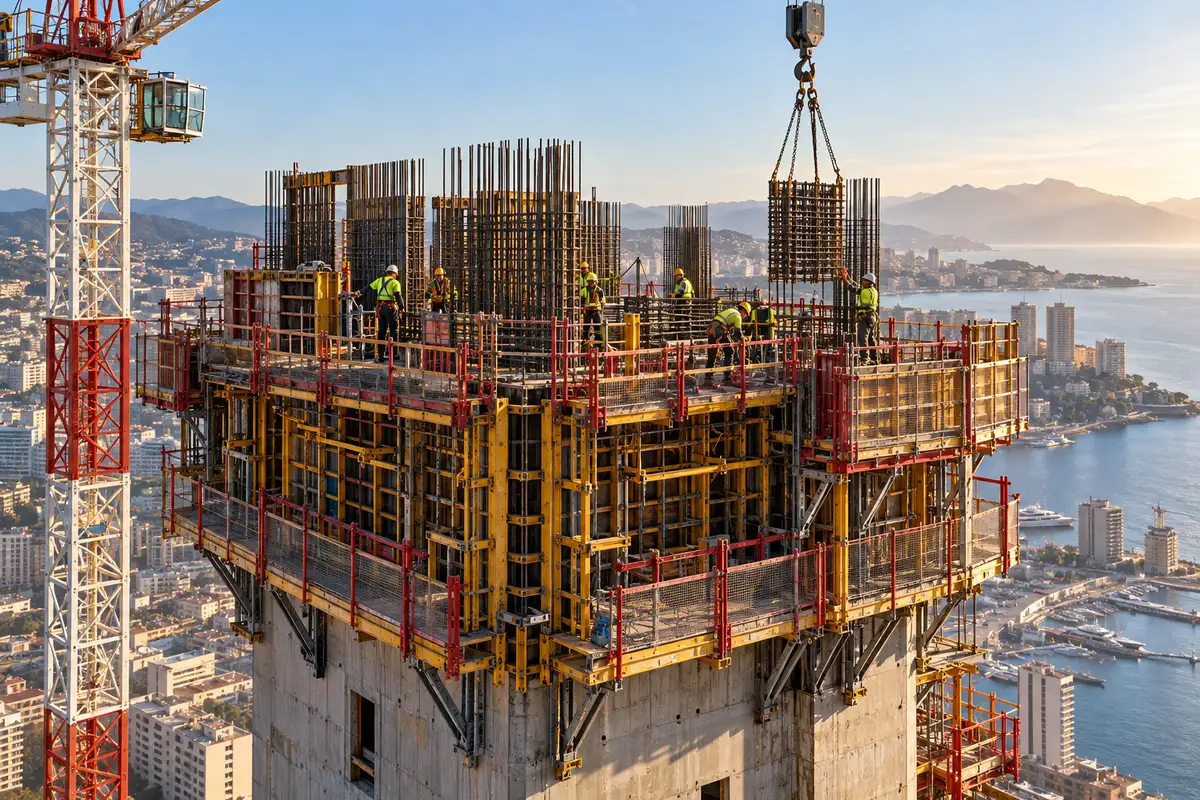
Self-climbing formwork is a set of wall forms and working platforms fixed to the core itself. After each pour, once the concrete is strong enough, hydraulic jacks lift the whole system to the next level along rails anchored in the walls below. The crane is free for other lifts, and the crew works from the same platforms all the way up.
One climb, step by step
Pour
The walls of the current level are cast inside the forms.
Cure and test
The concrete gains strength; samples confirm it before anything moves.
Strike
Forms are pulled back from the new walls.
Climb
Jacks lift platforms and forms one level up the anchor rails.
Fix
Reinforcement and embedded items for the next level go in, and the cycle repeats.
Why the core leads
A core a few levels ahead of the floors gives the frame a stable spine to tie into, keeps the critical lifts and stairs moving up early, and separates two crews so they never wait for each other. That gap between core and slabs is one of the first numbers we fix in any tower rush plan.